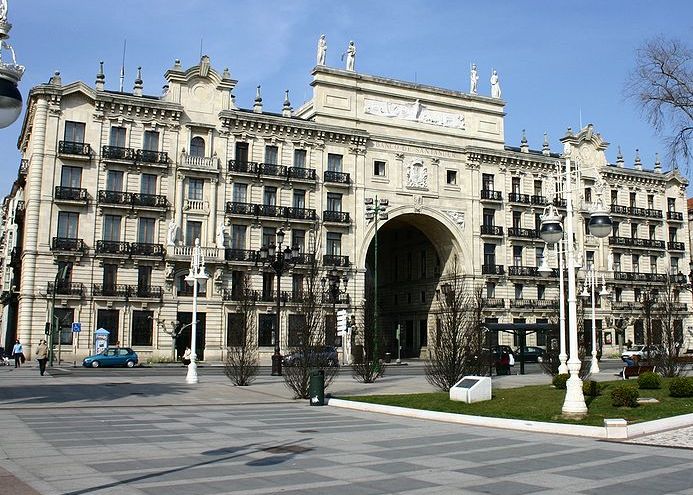
 Early in 2010 Babergh District Council decided that it was time that we had a formal Treasury Policy. We had avoided placing surplus funds with the Icelandic banks and it was right that the Council formalised its deposit placing policy. A consultant’s report was commissioned and presented to the Overview & Scrutiny Committee (Stewardship). Strangely it suggested that placing deposits with Spanish banks would meet the Council’s requirements for prudency. There was a fair amount of argument and full Council finally decided that if the Consultant said so, it must be OK! No suggestion that there were other persons on the council who were equally in tune with economic trends and who thought that the Spanish economy was over ripe. Within three weeks of the Council’s decision the Spanish economy was downgraded and any deposit placing with any branch or subsidiary of Santander was prohibited.
Where Babergh leads other Councils follow. The digital version of MJ (presumably an updated name for the Municipal Journal) reports that “Several local authorities are considering whether to deposit money with the British arm of Spain’s biggest bank Santander, amid fears about the weakness of the Spanish economy”.
The full article can be found on http://www.themj.co.uk/MemberPages/Subscribe/article.aspx?id=188729
It’s hard to be humble!
Babergh
Development Framework – Pollution Levels 18th August 2011
The Draft Core Strategy for Babergh is considered by the Council’s Strategy Committee.
The document is 116 pages plus appendices. Regrettably there is no comprehensive table of contents (page numbers are omitted) nor is there an index. The obvious question is whether this is deliberate. A document which has taken years to put together is debated for less than a day. How many councilors in the towns and parishes will read through the document?
However Page 6 Key Environmental Issues includes:
CO2 levels of emissions in the Babergh District are above regional and national averages and this part of East Anglia is particularly vulnerable to the effects of climate change. It is therefore important that we look at ways to contribute to reducing climate change in the district including more sustainable energy generation and energy use / conservation.
Traffic congestion, and air pollution due to traffic are also important issues in some parts of the district. The potential pollution hotspots relate to the A12 and A14 trunk roads and the A131 southern approach to Sudbury, which carry relatively high volumes of fast-flowing traffic. The Ballingdon Street, Cross Street and Church Street area of Sudbury has been designated an Air Quality Management Area (AQMA) as a consequence of traffic congestion and air pollution.
The above average pollution level assertions apparently come from a 2008 publication from Suffolk County Council. Page 55 of the Development Framework gives an indication of some of the measures to be taken to reduce greenhouse gases but nothing is specific. I suspect that the figures and the conclusion are out of context or otherwise flawed. It’s possible that the A12/A14 Copdock interchange has been monitored but this junction is not representative of the District. (see http://www.streetmap.co.uk/newmap.srf?x=611500&y=241500&z=3&sv=611500,241500&st=4&ar=Y&mapp=newmap.srf&searchp=newsearch.srf&ax=611500&ay=241500)
The hunt for truth (and its consequences) continues.
 brian riley's blog