“Population is key . If you don’t take care of population, schools can’t cope, hospitals can’t cope, there’s not enough housing – there’s nothing you can do to have economic development.”
Peter Ogunjuyigbe, a demographer in Nigeria, where women have an average of more than five children. The quote is taken from the New York Times today. However the message is true whether you are talking about Hadleigh, Babergh or the world at large. It’s all about housing, jobs and infrastructure and the driver is population. Otherwise we open the doors to the four horsemen of the Apocalypse.
http://www.nytimes.com/2012/04/15/world/africa/in-nigeria-a-preview-of-an-overcrowded-planet.html?nl=todaysheadlines&emc=edit_th_20120415
Author: Brian Riley
Episcopalian’s Guide to Airport Security
 Today’s Daily Reckoning (e-mail publication by Moneyweek) contains an article by Bill Bonner first published on 3 June 2002 discussing airport security and from there to why the policy of attacking enemies first tends to be flawed.
Historically Bonner refers to Napoleon and Hitler but the sub text is Iraq. The article is (as usual) well written and contains the following gem:
common sense finds few buyers… while absurdity is over – subscribed.
The full article is found on http://www.moneyweek.com/news-and-charts/economics/us/bill-bonner-the-episcopalians-guide-to-airport-security-21400
Touched by Angels
 I have just finished reading Touched by Angels written by Derek Jameson in 1988. Jameson began life as an illegitimate in Hackney (East London) in 1929, was educated at very basic schools and started work at the age of 14 (as many did) as a messenger in Fleet Street (Reuters).
He ultimately became editor and managing editor of many popular newspapers including the (now defunct) News of the World. In 1984 he lost a slander case against the BBC who referred to him as “an East End boy made bad”. The phrase was considered defamatory but also fair comment (and therefore) not actionable. Jameson was bankrupted with the £75,000 total costs of the action.
The autobiography is summed up by Jameson’s own words: “It is really the story of a fight for survival. What makes Jameson run is not a desire to lie on the beach in Bermuda nor drive a Rolls. Rather to make people aware of my existence, to be considered as good as the next”
And that for the most part defines us all.
Monetary Trends
 Moneyweek is as the name suggests a weekly magazine looking at money trends.
Its contributors include gold bugs, bond fanciers and equity analysers.
The 24th February edition (I’m a slow reader!) contained the following three contributions:
My money goes on Tim Price (the third contributor) especially for his last sentence:
Simon Caulfield wrote:
James Grant, publisher of Grant Interest Rate Observer, likens inflation to tomato ketchup. You can shake the bottle for ages and nothing happens. Then suddenly, your dinner is drowning in the stuff. My advice? Own investments that gain from a weaker pound and rising inflation – and buy Asian currencies and gold.
http://www.moneyweek.com/news-and-charts/economics/global/what-if-this-is-not-a-financial-crisis-57740
Matthew Lynn wrote:
Countries with low debts are more stable – just as companies and households with lower debts are. With balance sheets in decent shape, they are better placed to withstand fluctuations in the economic cycle. Nearly all the low debt countries are emerging markets. Slowly investors are realising what is happening. Emerging markets offer greater security and now higher yields. With younger populations, smaller governments, less welfare and lower taxes, they grow faster. Increasingly, the question may well be not how much money you want to have in the emerging markets – but why leave any at all in the developed world?
http://www.moneyweek.com/investments/stock-markets/universal-truths-of-investment-turned-upside-down-57718
Tim Price wrote:
Whenever the market anticipates yet more quantitative easing, markets go risk-on. Whenever the market fears the withdrawal of quantitative easing, markets go risk-off. And governments and their central banks are either pumping the accelerator or toying with the brakes. If, like me, you fundamentally fear money-printing, hold gold. If you think the printing will stop, hold quality bonds. Depending on your views of China, it may make sense to hold (or completely avoid) commodities, and in most circumstances it makes sense to own quality blue-chip stocks. But if you can foresee what lies ahead, you’re a better man than I am.
http://www.moneyweek.com/investment-advice/how-to-invest/strategies/investing-in-an-age-of-monetary-anarchy-57726
The above commentary is for general information only and is not intended to be relied upon by individual readers in making (or not making) specific investment decisions. Appropriate independent advice should be obtained before making any such decision. Always seek personal advice if you are unsure about the suitability of any investment.
Small Successes
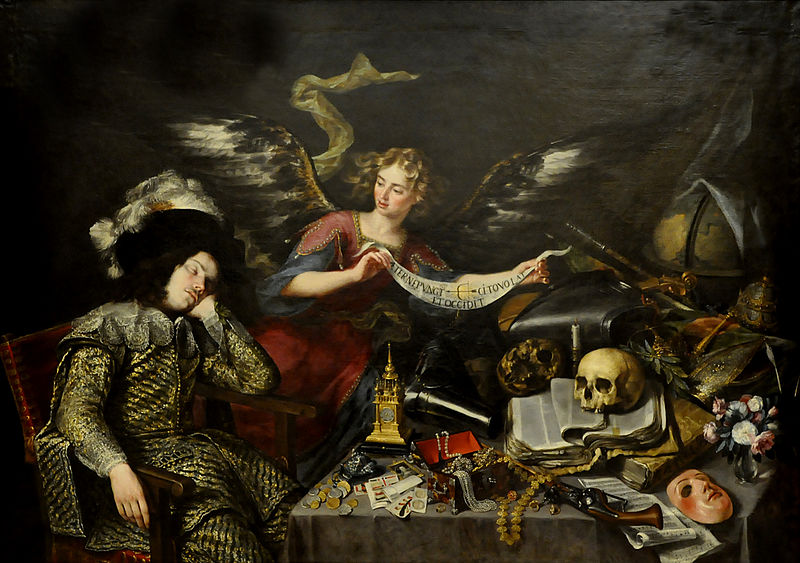 Today’s meeting of Babergh District Council’s Overview and Scrutiny (Stewardship) Committee was a quite sparky meeting with much debate focussing on the Finance, Risk And Performance Management – Quarter 3 Monitoring Report (35 pages of facts and figures). The general complaint was that although we are told when targets are not being met – we are not told what is being done to correct the position. Cynics would say that the mushroom principle applies. The view being that it is not the Councillors’ role to understand what is going on but merely to note (and if appropriate approve) the reports. But deep in the data is the wonderful news that Babergh Matters (The Council’s publication for residents –sometimes up to 24 pages of photos and pufferie) has not been published this financial year generating a saving of £41,000. It’s possible that the £41,000 could be carried forward into 2012/13. But a saving is a saving and I have campaigned against the publication since I was first elected in May 2007. Consequently my day was cheered up immeasurably.
FIND (Families in Need)
Tomorrow (Saturday) 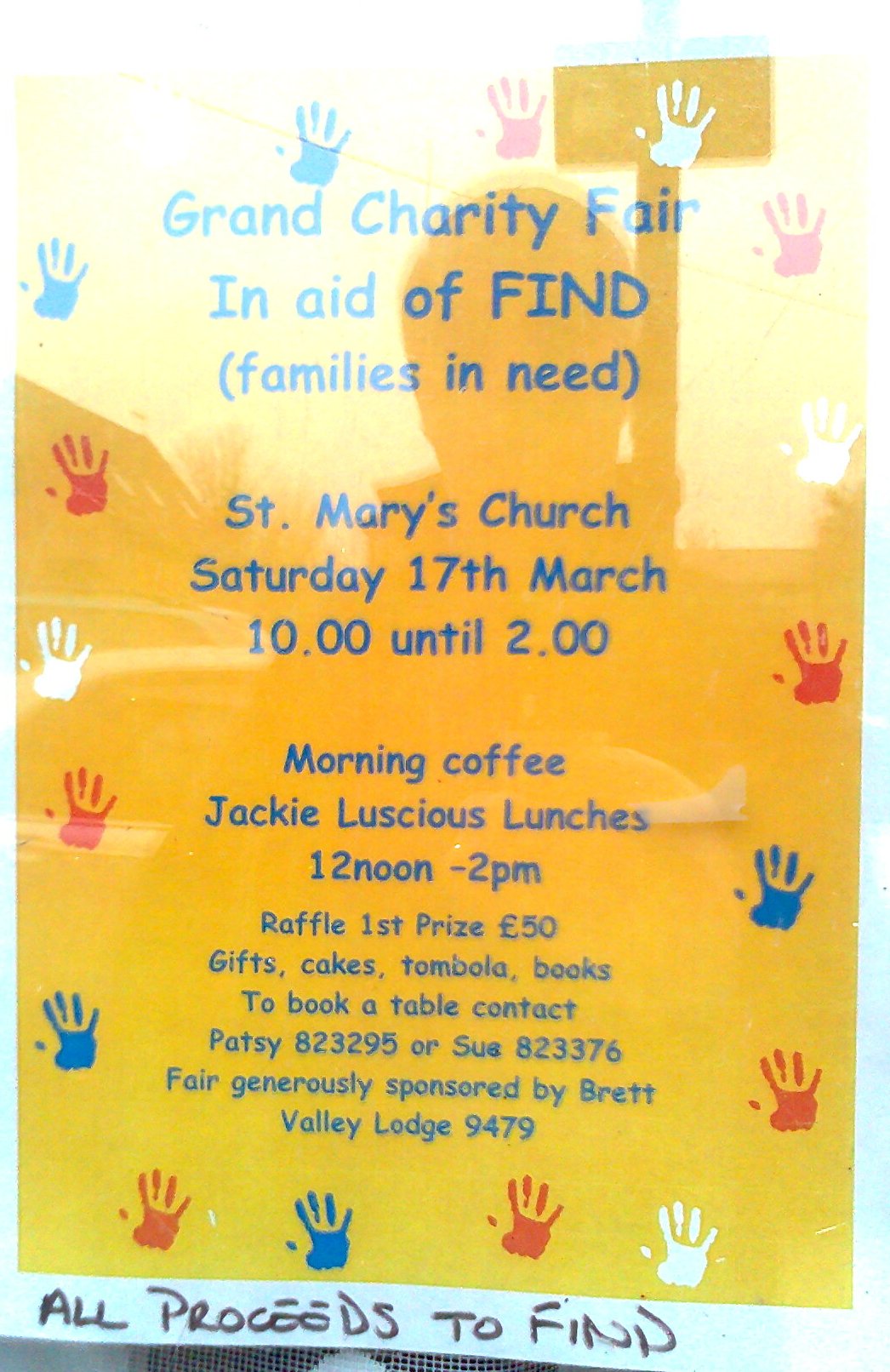 FIND (Families in Need) is holding a fund raiser at St. Mary’s Church Hadleigh from 10 until 2. With the current changes in the economy FIND is having to provide basic necessities like food to families in need. This is a local charity which deserves our support. If you’re free and in Hadleigh on Saturday, drop in to the church and see what’s happening. Short term (three hours) car parking in Hadleigh is free until noon on Saturdays. Thereafter parking is free for all of Saturday afternoon and evening. If you are visiting Hadleigh be careful of using the long term car parks which although they are also free for the first three hours will require a parking ticket up to 5 p.m. FIND is a Christian based charity that was founded in 1990 to provide emergency assistance to families or individuals affected by poverty or dispossession. FIND is also able to offer ongoing friendship and support to those in need. WHAT DOES FIND OFFER? The charity provides, free of charge: food; cooking utensils; clothing, toiletries; baby equipment & nappies; bedding; survival sleeping bags; curtains & furniture; white goods; Christmas hampers & gifts, etc. FIND also befriends people without judging them, offers advice when required and gives support for as long as it is needed. WHO DOES FIND HELP? Anyone living within 25 miles radius of Ipswich who is deprived of a minimum standard of living, be they single, families, lone parents, children, elderly, sick or disabled. Referrals may come from: Social Services; General and Psychiatric Hospitals; The Homeless Family Unit; Victim Support; Salvation Army; Asylum & Refugee Support Agencies; Women’s Aid; The Probation Service; YMCA & YWCA; Ipswich Community Resource Centre; Family Centres; Health Centres; other charities.
Not the Whole Truth (2)
Not  all cardinals have spotless reputations. “Not the Whole Truth” (1971) the partial autobiography of Cardinal John Heenan contains the following vignette:
“One of our escapades (invariably leading to an official complaint to the school) was to change compartments (of the train) between stations. This involved climbing out of our compartments and walking along the footboards. It can be dangerous even to lean out of a window…We foolish boys were unaware of the potential suicidal aspect of our exploits – misadventure is never very far from youthful adventures. We were delighted to shock the adult passengers. We were not malicious. It was only that we were too immature to appreciate that it was not very clever to alarm our elders.”
Not the Whole Truth
I re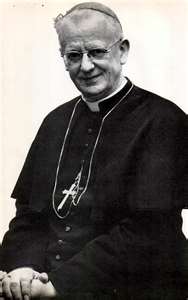 cently read “Not the Whole Truth” (1971) the autobiography of Cardinal John Heenan up to the point when he was made Bishop of Leeds in 1951. In many ways it is a book with bits worth skipping. On the other hand he did visit Russia and Germany prior to 1939. (In both cases travelling incognito). An interesting extract relative to the current debates as to whether England is a secular or a religious society is as follows:
“When Mr Butler (1941 President of the Board of Education) began to outline a new education bill (which became the Education Act 1944) it was obvious that the Government intended to give religion a more prominent place in the curriculum. It is impossible to be certain of other people’s motives but I think the politicians were genuinely alarmed by the paganism of Nazi Germany and felt that the British as Christian crusaders should teach young citizens more about Christianity…That is why in the new Act it was proposed to include a daily act of worship and an agreed (non-denominational) syllabus of religious instruction.”
My Part of the River
I hav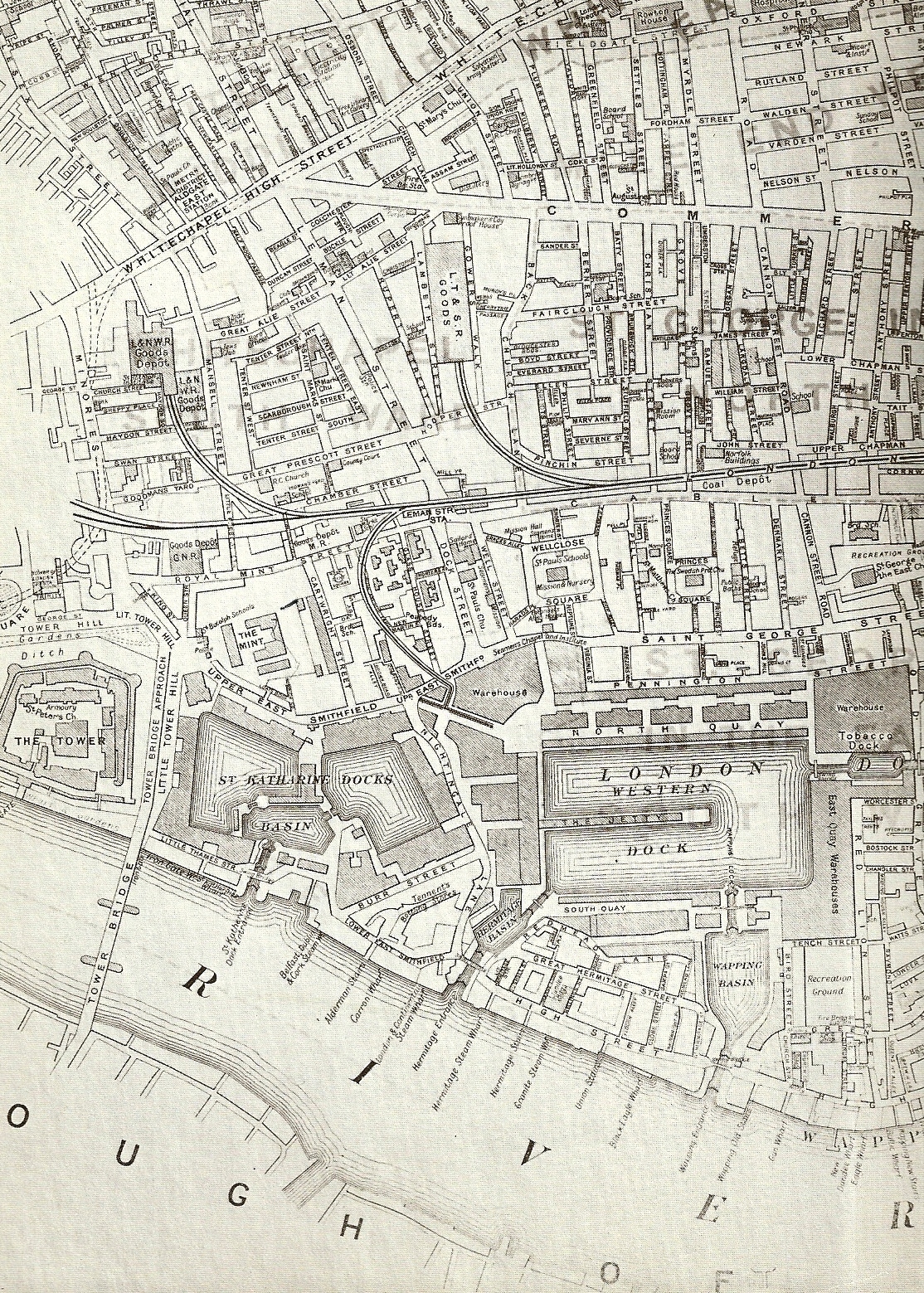 e just finished reading My Part of the River (1974) by Grace Foakes which deals with much of her childhood and early adulthood in Wapping (East London). Grace Foakes was born the year Queen Victoria died (1901) and would thus have been ten years younger than my grandmother (Alice Luck) – so much of what Grace writes has family resonances. One quotation which sticks out is: “They were happy days in that close-knit community. The feeling of belonging outclassed everything else. There was poverty, disease, dirt and ignorance, and yet to feel one belonged outweighed all else.”
Edelweiss
 Roger Lewis wrote in the Telegraph on the 16th February 2012:
The popularity of The Sound of Music occasioned one of the prime moments of my childhood. “You remind me of that song in it,” my mother said to my father one day. “What, My Favourite Things?” he replied smilingly. “No,” said Barbara Mary Lewis (née George), “Idleswine.”
 brian riley's blog