Hessel Street, London – an Appreciation

On Sunday 16th December I attended a late Chanukah party at the Triangle Jewish Genealogical Society, just up the road from Raleigh, North Carolina.
One of the features of the afternoon was a Kvel & Tell and I delivered the following introduction to the film “The Vanishing Street” which focusses on Hessel Street in London’s East End.

“Ladies & gentlemen and Debbie, very many thanks for inviting me here today to Kvell and Tell about the film, “The Vanishing Street” (which is showing behind me – but with the sound switched off) which tells of Hessel Street in London’s East End.
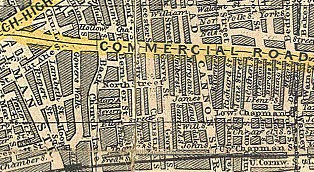
We are going to deal with Hessel Street’s place in East End social history and its place in my family history and in my wife’s family wanderings.
What qualifications do I have for being here today?
First my great grandparents lived in Hessel Street in 1883 when it was called Morgan Street. In 1901 Alice’s grandfather stayed in the adjacent Christian Street when he was a jobbing tailor en route to the United States from Roumania.
Hessel Street is famous as a Jewish Street Market.
Eric Levene, author of Feinstein’s Theory of Relatives writes of Hessel Street, much in the manner of Damon Runyon with his ability to place people and events in time and geographical location

“In the beginning, there were no Jews.
But by the 1920’s, Hessel Street market, in the heart of London’s East End was full of them. There were butchers, bakers and chicken soup makers, costermongers and a host of wheeler-dealers and luckless shpielers.
A 200 yard long and maybe 10 yard wide sardine tin, crammed full of vibrant Jewish life and, as nature would have it on occasion, death. They came from all over. There were Poles & Russians, Latvians and Lithuanians, Moldovans, Ukrainians, Rumanians and Georgians, plus a multitude of others who had escaped the pogroms that had been raging across Eastern Europe.
And remarkably, they all got along with each other without the need to argue; unless they needed to”.

Anyone of a certain age with an East London connection will be aware of Hessel Street and its place in social and mercantile Jewish East End and many more will have heard tales of it from parents and grandparents. There is a Facebook Group of Hessellters and they meet and hold informal lunches in Westcliff, Essex near the mouth of the Thames.
The Vanishing Street is a wonderful 20-minute documentary film and is readily findable on Youtube. It was made in 1961 as the bulldozers moved in to demolish the street’s decrepit old buildings.
By then the market was almost a relic.
This film purports to show a typical day in the life of the street, and its declining but still vibrant Jewish community
The film begins with a smartly dressed surveyor with his theodolite, measuring up the street for demolition as the market stalls are being set up and the locals, meet, chat and go about their business
We see old men with black hats and long beards, sizeable ladies with loud voices, Wurst and viennas, fish (including I think a conger eel), pots and pans, dresses and toys, a barber’s shop and a dress factory with dozens of women at their Singer sewing machines.
By 1961 the market was almost a relic. The London Docks were moving to Tilbury and people were being decanted out of the area into nice new more sanitary housing in the new towns of Harlow and Basildon.
There were still many Jews in the East End but nothing compared with a few decades earlier.
Economic progress and the Blitz had moved them on.
The joke was always that Stepney Borough Council always saw its purpose as demolishing the buildings which the Luftwaffe had missed.
In the early 20th century Hessel Street was the East End’s main Jewish market, open every day except Saturdays
The narrow street was filled with small shops and stalls
Chickens and other poultry were kept in cages; buyers selected one, had it killed according to kosher ritual and dressed while they shopped elsewhere
There were also many wet fish stalls, and general shops
Possibly it was the last of London’s ghetto markets
I have a cousin in London who recalls that her mother always bought her chickens from the “Jews Market” because of the freshness and the quality – even though the Watney Street market had cheaper chickens and was closer to her home.
In Hessel Street, and in much of the East End, Jewish life has been replaced by Bangladeshi life – and there are hints of this in the film.
The kosher poulterer has been replaced by the Halal butcher.
Jewish market stalls have been replaced by Bangladeshi stalls, selling very similar things
Jewish poverty has been replaced by Sub-Continental poverty and Jewish striving by their striving
What is said today about the people fighting their way into Europe absolutely echoes what was said about Jews between 1880 and 1905 when millions fled from Russia and Poland
Then as now there were people traffickers.
Then as now people were fleeing desperate circumstances
Then as now there were the unchanging complaints about immigrants and their strange ways of life
In 1871, before Jewish immigration, the average occupancy of a Whitechapel house was just over nine people, in 1901 it was close to 14
At the beginning of the 20th century, there were 120,000 Jews in the East End
Now there are very few. As the years passed, people moved away to more comfortable places.
Where there were over 100 synagogues – today there are only three
Seen today, The Vanishing Street is a nostalgic film but not a sad one
The East End was somewhere to flee to and somewhere to escape from.
Thus we see in the film, the continuing dynamic of street life and everyday life because as we all know “For things to remain the same, everything must change”
And that concludes my Kvell and Tell on The Vanishing Street.
Thank you for your patience and attention”.

It went down well and there was a lively Q&A afterwards. The East End diaspora is everywhere!
How the West was Won

I have occasionally blogged on the joys of Aberystwyth and its place as a University town in the far west of Wales. The story is that its railway line escaped axing in the Beeching era, not because the line was profitable but because it ran through five Labour held parliamentary constituencies.
It is a nice place to visit, not just because we have family there but because of its indomitable spirit of activism despite the efforts of the City fathers.
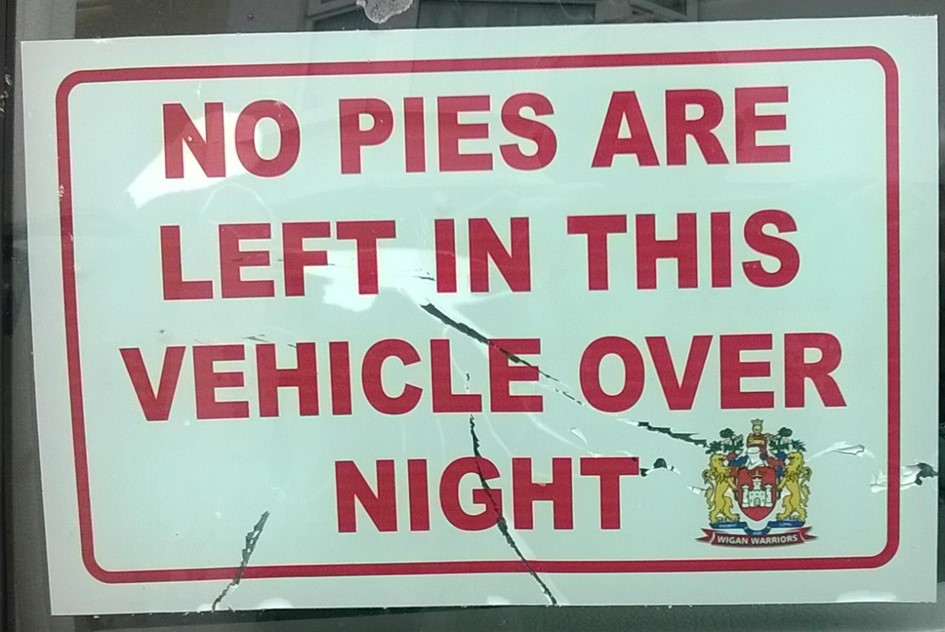
This spirit is exemplified by the sign I saw in a car window.

Does it mean that Aber is overrun by ravening hordes who will smash a car window in search of stale (or otherwise) food. No, it means that if due to idiosyncrasies in the licensing laws, the pie shops close before throwing out time at the local bars, then there is no profit to be found scavenging in the parked vehicles looking for left over sea gull food.

Steroids & Caffeine

JeremiahFrom time to time I read one of the lessons at the Holy Name of Jesus Cathedral in Raleigh. The first reading on July 22nd is from Jeremiah. Normally I like to avoid Jeremiah and Job as they are not the most cheerful of prophets and I prefer to enjoy the more declamatory words of Isiah, Ezekiel or Nathan.

The reading on the 22nd is about the negligent “shepherds” of the people who deserved better leadership.
Much of Jeremiah’s work was in Judah’s capital Jerusalem. He tried to keep several kings faithful to their stewardship  amidst an atmosphere of political intrigue and backstabbing. Jeremiah was blunt about what was right and what was not, and he suffered at the hands of the powerful because of his outspokenness. At the time of his prophecy, a good king in Judah had just been replaced by a king who put the country in thrall to Egypt. Jeremiah raged against this policy.
The reading is Jeremiah’s response to the negligent leaders. I first read the passage as a reproachful piece but looking at the readers’ notes I was encouraged to see that it is proclamatory and that I should not let Jeremiah sound like he’s on Valium. If anything, he should sound as if he is on steroids and caffeine.
He was a vigorous, courageous, outspoken man. He thunders on behalf of a God outraged at the powerful people’s neglect of their responsibility to the poor. “I gave you the privileges of a shepherd, you mislead and scatter the flock!”
Any linkage between the events and characters of 200 B.C. and the present day are purely unintentional and coincidental.
On the other hand, I think I’ve known some readers for whom Valium is the default mode when tackling the readings. But for me, for this week at least it’s a case of onwards with the steroids and caffeine!

The Rain Makes All Things Beautiful

The full verse continues Flowers and Grasses too. And, I like to think that it also makes houses beautiful.
Our house is now listed on the Weichert Luxury Homes site and as the sun comes out it can only look better in real life than it does in the photographs
The winter in Raleigh has been quite brutal from time to time. Not so bad as in the North East of the country but occasionally quite harsh with overnight temperatures in the lower twenties Fahrenheit.
So, today I was quite pleased to see that the beautyberry has survived in its exposed position and is showing some small tentative green shoots. The Hypericum is looking set to flourish and the early Azealia’s are acting as though Spring has finally sprung. On the other hand, the Crepe Myrtles and the Dogwood are evidencing distinct signs of remaining under the duvet until it is absolutely safe to come out.

Blessed with Politicians

Larry PittmanIn North Carolina we are blessed with some of the most creative thinkers in the political landscape.

Take for example N.C. State Representative Larry Pittman
In the wake of the Parkland, Florida, shooting, Americans were asking why would someone do something so terrible?
Experts say it’s often a combination of mental illness, adversity in the shooter’s life – and access to guns. Larry Pittman took the speculation a step further.
He speculated on Facebook that the shooter, Nikolas Cruz, had political motivations and suggested the Florida shooter was part of a conspiracy to push for gun control so they (the communist Democrats) could more easily take over the country.
Larry is well known for his ahead-of-the-curve thinking. Last year, he proposed a constitutional amendment that would allow North Carolina voters to repeal that part of the North Carolina Constitution, which declares that “This State shall ever remain a member of the American Union; the people thereof are part of the American nation,” and prohibits the state from seceding from the United States of America; The amendment is currently languishing with that committee which runs the Legislature’s timetable.
Larry has been a registered Republican since 1972, when he was 17. He posts that he is proud of the fact that without his votes Jesse Helms would have never won elections to the US Senate, nor Ronald Reagan’s  elections as President.
We are truly “blessed”.

For more information please see http://www.newsobserver.com/news/politics-government/state-politics/article200807499.html

What does $2.3million look like?

MoneyThe reports of the $2.3 million missing cash from the Wake County Register of Deeds office raise as many questions as answers. $2.3 million over nine years is an average of $21,000 a month which for some people could be yearly earnings.
Reports tell us the who, what and the how.
We do not know the why or where the money has gone.
As a former Bank Chief Inspector I would always look for motivation in gambling, drugs and extra marital dalliances. Where has all the money gone? It can’t all have gone on riotous lifestyles? Has it gone to family, colleagues or financing elections? It can’t all have been frittered away, can it?
For more details please see Charlotte Observer of August 28th

This is What I Like about the South

Feeling the need for an Independence week end getaway we decided to take ourselves down to Kinston and visit Kings BBQ Restaurant.
Kings BBQ Restaurant feeds Eastern NC barbecue lovers locally and nationwide, serving 8,000 pounds of pork, 6,000 pounds of chicken, and 1,500 pounds of collard greens a week! So it is obviously well recommended.
My initial curiosity was sparked by a clip as part of a NC tourist promotion and the YouTube extract is worth watching.
I had the pulled pork (which is why we went) and as a side dish I had the collard greens which are cooked with bacon. Together with the fried okra and freshly cooked chips we couldn’t manage a dessert – so we brought the pecan pie home with us. And yes, being well brought up and skilled in these matters I would never put ketchup on NC barbecue pork.
Kinston has a population of 21,000. The area is very agricultural – where else would you see highway billboards extolling the virtues of pesticides and fertilizers? The farmland is characterized by tobacco which is an indicator of poor soil. Kinson was badly affected by Hurricane Matthew last October
 as the restaurant marker shows.
It was a good trip and a very nice meal – plain homestyle Southern cooking at its best. The restaurant was pleasantly full but not crowded and our waitress Tina bustled around like the true professional she is.
Is it on the list for a revisit – yes it is!

Dragon Arts

Wales is renowned for its artistic genes. Artists and bards spring up everywhere. After all Aberystwyth boasts my son in law as a sculptor in residence.
Last month the Ceredigion coast experienced some late spring gales and among other detritus a tree washed up on the beach.
If as Michaelangelo  said “Every block of stone has a statue inside it.” then every piece of wood harbours an artistic expression that wishes to
emerge like the butterfly from the cocoon.
So it was with no surprise that one morning we discovered that the tree trunk had been transformed into a dragon complete with (dead) 
spider crabs for eyes.
As can be seen, my grandson is a true native of Wales and shows no fear of dragons!


Wags4Tags

There is always plenty of doom and gloom wherever you look. Sometimes the morning news makes valiant efforts to stress the nice things about the day – such as spring blossoms but often the focus is on pollen and the associated allergies (welcome to my world). On the other hand there are many people making significant and beneficial changes to people’s lives. I came across one such person at the Triangle BABCNC Tra’Li Networking Social where I met Vivienne Carosso who is a key member of the Wags4Tags team. Basically Wags4tags unites psychologically and emotionally impaired Veterans across North Carolina with trained Companion, Emotional Support Dogs rescued from kill shelters so the two can heal in unconditional love, trust and loyalty. They are coming up to their 50th pairing so all credit to their President and Founder Ronnie Sadoski Trained animal companionship can help Veterans in their readjustment to civilian life by easing their symptoms and providing assistance, unconditional love, trust and loyalty.   There are many ways to support this enterprise. It takes up to $2,000 per dog to prepare it for his/her new Veteran-owner. This includes, but is not limited to rescue/adoption fees, and cost to spay/neuter, vaccinate, treat for heartworms, take care of other medical issues (such as eye infections, flea infections), micro chip, feed, foster/train, certify. None of these costs are passed on to the Veteran. The contact for Wags4tags is WAGS4TAGSNC@gmail.com Wags4Tags is entirely volunteer-based, and all donations stay in North Carolina. 98% of all donations go directly to rescuing, vetting, training, and matching a dog to his or her new Veteran, including any and all supplies the Veteran will need.

Clearly, we are doing something right!

Last Friday (3rd March) Raleigh Mayor Nancy McFarlane delivered the annual State-of-the-City address.
Key front-end points for residents and potential residents were:
Raleigh continues to be recognized nationally and internationally. Some of Raleigh’s accolades from the past year include:
#3 Best Large City to Live In
#2 Best City for Young Entrepreneurs
#6 Best-Performing Large City in 2016 : Miliken Institute
#2 Area with the Highest Number of Tech Jobs-
NY Times Forbes Magazine has ranked Raleigh:
#2 Hottest Spot for Tech Jobs
#3 Best Place for Business
#3 Best City for Young Professionals
#4 Best City for Mid-Career Professionals in 2016
#4 Easiest City to Find a Job #5 City of the Future
#9 in the Top Ten Cities Americans are Moving to Right Now
#9 Best City for Jobs.
And just last month, U.S. News & World Report named Raleigh the #4 Best Place to Live.
The population continues to grow by about 2.3% annually. We had some big announcements by businesses of new locations or expansions. Citrix is adding 400 jobs; Optum 200; WalkMe 100; and Ateb announced an investment of $3 million with the number of jobs still to be announced. All together in 2016 we saw a 4.3% increase in employment numbers.
Last year, 138 permits were issued for new commercial and industrial development; this was valued at over $800 million dollars. We continue to proactively position ourselves as a city of the future. The recent additions to our market of high speed gigabit fiber offer our residents more options in high speed internet service than New York City or San Francisco.
The city is working to provide more opportunities to make sure that Raleigh’s success is enjoyed by everyone that lives here.
Raleigh has always been and will always be an open, welcoming community to everyone that comes here.
The address can be seen YouTube: Mayor’s State of the City address
As the Mayor said “Clearly, we are doing something right!”