Six Principles for Happiness

Moneyweek features a blog by Eric Barker (http://www.bakadesuyo.com/archive/9/2012?page=2), which suggests that there are six key principles for happiness in life and career. (I particularly like No. 3 and 6).The principles are taken from Daniel Pink’s book, The Adventures of Johnny Bunko: The Last Career Guide You’ll Ever Need.

1.      Don’t plan. Things rarely work out as you intend them. Act instead according to your fundamental values and beliefs – this is more effective and rewarding.
2.      Think strengths, not weaknesses. Don’t try too hard to improve what you’re bad at; instead, capitalise on what you’re good at.
3.      It’s not about you. The most successful people improve their own lives by improving others’ lives. And they’re happier while doing it, too.
4.      Persistence trumps talent. What any one person in the world can learn, almost all of us can learn. What makes the best musicians? Nothing but hard work.
5.      Make excellent mistakes. The most successful people make big mistakes and learn from them – each time they get better and move a little closer to excellence.
6.      Leave an imprint. Visualise your funeral and consider what you would want friends to describe as your legacy. Thinking about death can actually be a good thing – it can improve physical health and help us re-prioritise our goals and values.   

Wattisham Flying Station

One of this week’s fortunate happenings was to be invited to a cocktail party and beating retreat at the Wattisham Flying Station. The last time I was mixing with operational military air crew was in Salalah in 1982. That of course was a different world. The young officers today have done their tours of Afghanistan and finished their Top Gun Training in the U.S. The Army reckons that it costs about £3.5 million to train Apache Helicopter pilots. You get a sense of what a machine the Apache is when it weighs over nine tons fully loaded and can be thrown around the sky at 180 m.p.h. Not that any throwing around is done. These machines cost around £35 million each. The cocktail party was fortunate insofar as Suffolk County Council are initiating a Community Covenant With The Armed Forces. On first reading the Covenant strikes one as being a tad flabby. It is apparently meant as first steps and obviously it cannot be a one size fits all as the various units and communities have different needs. I was in total awe of the personnel whom we met. They are very professional and certainly good value for money. They do deserve our support and one of my ambitions is to make it easier for our veterans to settle in communities of their choice – or as one veteran once put it to me “I can’t go back to where I enlisted. If I become homeless in Camden my wife will divorce me”. We need to work out better ways to support our military.

Wind Turbine

Courtesy WikicommonsI publish a monthly column in the Hadleigh Community News called Out of the Frying Pan. The point of the column is to highlight and comment on what is happening in Babergh from the point of our town. The aim is to be informative and occasionally entertaining. Hopefully I focus on some of the issues creeping under the radar. In July I wrote of a proposal for a 18 metre (59 feet) wind turbine off the Pond Hall Road. The 18 metres was from the ground to the top of the turbine and did not include the total height of the turbine blades. By contrast the only turbine in Hadleigh is only 9 metres high. The flag pole outside Babergh’s Corks Lane offices is 6 metres high. Although the site is in pasture, the turbine would be visible from the Pond Hall Road (400 metres/433 yards away) and would be extremely visible from the proposed housing area being planned for the land south of Tower Mill Lane and east of Frog Hall Lane. This week’s good news is that the planning application has been withdrawn. So a small triumph for common sense. Forward with the people

The Artist

At the weekend we took ourselves off to Leavenheath where the village hall was screening The Artist.  The hall is part of the Suffolk Digital Cinema Network (a non-profit association) which encourages community film screenings across Suffolk.  Network members borrow digital projection equipment, and get advice and training on how to run properly-licensed screenings in their own venues. Members choose the films they show to meet the needs of their local audiences. There were just under fifty people in the audience and it all went very well. There was a interval during which we could buy drinks and ice creams. I fully recommend The Artist which is a 2011 French romantic comedy-drama film in the style of a black-and-white silent film and stars Jean Dujardin and Bérénice Bejo. The story takes place in Hollywood, between 1927 and 1932, and focuses on the relationship of an older silent film star and a rising young actress as silent cinema falls out of fashion and is replaced by the “talkies”. (A sort of Singing in the Rain without the wetness).  Some might argue that the real star of the film is Uggie, Dujardin’s Jack Russell .
Sound finally comes in as the film starts rolling for a dance scene with Dujardin and Bejo. Once the choreography is complete, the two dancers are heard panting, and this is only time in the film sound is heard coming from Bejo, who otherwise says nothing. The director of the musical calls out audibly, “Cut!” to which producer adds: “Perfect. Beautiful. Could you give me one more?” Dujardin, in his only audible line, replies “With pleasure!” revealing his strong French accent. The camera then pulls back to the sounds of the film crew as they prepare to shoot another take.
Well worth a trip to one of the villages and well worth seeing the film again

Beyond Comfort Food

I was in London and passing through Liverpool Street station and feeling in need of comfort food I stopped by the Pasty Shop and chose a steak and stilton Cornish pasty. It was only as I was walking away that I noticed that in addition to the usual varieties available (lamb with mint, etc.) they also had a pasty filled with fish, chips and mushy peas – all the necessary vital foods for life. Certainly something to put on the list for next time.
In the meantime my favourite council is embarking upon a series of consultations. One of which focuses on the support we give to families with their Council tax and rents. We will be abolishing the discount for second homes (if you can afford a second home you can afford the council tax!) and also we (the taxpayer) will not be paying for houses which have an above average assessment. (Large families would be accommodated by other pockets in the benefits system).
A survey by the Taxpayers Alliance has discovered that super-sized families are being housed by councils across the country in huge mansions that many mortgage payers could only dream of. The biggest council house provided was a 10-bedroom abode in Southwark, while East Riding Council placed a family into a nine-bedroom home in Bridlington. Robert Oxley of the TaxPayers’ Alliance said: “This is why the Government must press ahead with its proposed cap on housing benefits”.
Patience Wheatcroft in Monday’s Evening Standard makes the interesting point that most business people would say that what they want most is for government to provide a stable, low-tax environment, and educated and properly skilled workforce, and then get out of the way. Which I can go along with, provided we have adequate safeguards for people and their environment – otherwise we might just as well start breeding smaller children so as to facilitate chimney sweeping and provide employment.

Tilting at Windmills

Whilst in Paris we took the opportunity to treat ourselves to the International Herald Tribune which combines the New York Times news services together with features and articles from elsewhere. It made a refreshing change from the U.K. national papers and we did consider swapping our Telegraph subscription for the I.H.T., relying on the internet for more U.K. centred news.
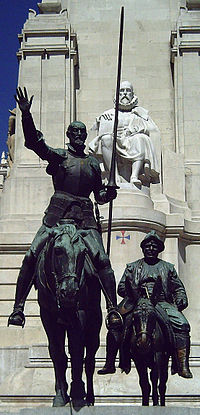
One breakfast meeting was made joyful by the news that Spain is bidding to host the Olympic Games in 2020. A Wall Street Journal article contained the following extracts:

·“We need two different things: power for the economy and an element of enthusiasm for the population,” Víctor Sánchez, managing director of Madrid 2020,
·
Skeptics point out that Madrid is among the most indebted cities in Spain. Ratings firm Fitch recently downgraded Madrid’s regional government, predicting its debt could more than triple—to €23.7 billion ($29 billion)—in 2014 from 2010. The country’s economy, meanwhile, is enduring a double-dip recession and the government is pushing through a €65 billion austerity program.
·
“This is not the moment to be thinking about this kind of event,” says José García Montalvo, an economics professor at Barcelona’s Universitat Pompeu Fabra.
·
”In these bid documents, there is always an element of unreality,” says Matthew Burbank, a political-science professor at the University of Utah who studies the Olympics.
·The IOC gave Madrid the best score of all three finalists, but added: “Careful monitoring of Spain’s progress on economic issues is needed to further assess future risks of delivery.”
It’s good to see optimism combined with ambition in these dark days. On the other hand the lunatics are thinking that they may be in charge of the asylum. The full article may be viewed on:
http://online.wsj.com/article/SB10001424052702303644004577524684025592386.html

The Fair Haired One

We have been in Paris for a week’s break. I decided one day to visit the church of St. Sulpice in Saint Germain des Prés. Overall the visit to St. Sulpice was not as fulfilling as I would have liked. I had been impressed by books recommending the Delacroix murals. It may have been that the paintings needed cleaning or that the lighting was inappropriate (it was a cloudy morning) or that I couldn’t stand back far enough to take in the mural of Jacob Wrestling with the Angel as a whole. St. Sulpice remarkably seemed to have found its pastoral role quite early and includes in its alumni St. John Baptist de la Salle (founder of the Christian Brothers) and St. Vincent de Paul. Surrounding shops are famous for containing religious medals and other devotional items (of varying quality). I declined to purchase an icon apparently showing St. Raphael. I thought it a bit so what-ish especially as this angel did not have wings nor did it show a dog. The morning was saved.  My footsteps were guided by a caring angel (possibly St. Raphael – the patron saint of travellers) to The Coolin (The Fair Haired One) – an Irish pub. The steak sandwich was cooked nicely rare.. The waitress was a young Irish lady  and the red wine eminently passable. My mood had mellowed by the time coffee was finished as can be seen by the photo of yours truly. Is this a vision of heaven? – Just look at the background!Overall I recommend the Coolin and it was quite well patronised by local people.

Away with the Pylons

I was reminded this week of The 4 Disciplines of Execution (by Stephen R. Covey) which  talks about prioritizing goals and achieving results with excellence The first of the four disciplines is to focus on the wildly important (goals).

Thursday saw me at Babergh’s Strategy Committee meeting where we were to discuss the Council’s position regarding the National Grid’s proposals for pylons across our countryside. One of the speakers (Michael Woods, Chairman of Layham Parish Council) reminded us that National Grid had described our landscape as “small and unremarkable” …”not particularly noted for its scenic qualities”. These are not opinions shared by the populace. The National Grid seems to regard our Areas of Outstanding Natural Beauty as fenced off theme parks with some form of rural or urban dystopia outside their boundaries! The Committee was unanimous in resolving that each and every section of the line should be placed underground …(and) that in addition to requiring the new line to be placed beneath ground the emerging opportunities for undergrounding the existing lines through the Dedham Vale Area of Outstanding Natural Beauty (AONB) and the Stour Valley should be exploited fully with the ambition of securing and maintaining a landscape free of high voltage electricity transmission pylons. Babergh will be working with Suffolk County Council and other district councils to present a unified response and approach to the issues.
A fantastic example of the Council plugging into the needs and wishes of the populace. Forward with the people!

Babergh Core Strategy

This week saw Babergh District Council consider  its Core Strategy. In many ways it is an admirable document setting out how the District might develop over the next twenty years. However, deep within its detail are what could be considered serious threats to the Hadleigh’s well being. Kathryn Grandon moved an amendment to the approving resolution pointing out that the commercial area allocated on the map is in the wrong place. The commercial area should not have to share street space with residential areas. Residential streets should not be sharing space with diesel lorries accessing their places of business twenty four hours a day. An illustrative map indicated the possibility of an industrial corridor to the east of Hadleigh. This will become an eastern barrier to further development since no one will want to be separated from the town by a commercial area. The commercial area should not be alongside the residential area. Instead it should be on a site having easy access onto the A1071 (the town by-pass) Once again we have a community being led by the Council but not  in a way which will enhance its future prospects. The amendment went down by more than thirty votes to six. One of the Liberal Councillors for Hadleigh voted against the amendment citing the need for a decision to be made. The Core Strategy has now been approved and has been published to the Towns and Parishes for further consultation. Then it goes to the Planning Inspectorate for comments and approval. Meanwhile people similarly minded to Kathryn and myself are looking at how one influences the Planning Inspectorate – as Babergh does not appear to be listening.

Watching the Gimbals

There’s a continuous theme in the film Apollo 13 where Mission Control is telling the crew to watch their gimbals. The gimbal being a device which indicates balance. There are many parallels in our other lives. Where was the balance in the Spanish banks? Deposits control your ability to lend and your asset and liability policies control what you can do with the money. Which is why the Spanish banking crisis is interesting as the asset policies obviously did not specify a prudent limit on financing speculative building. This week I attended a Revenues and Benefits Committee meeting. This committee comprises representatives from the three partners (Babergh, Mid Suffolk and Ipswich Borough Councils) and the Management of the Revs and Bens Joint Venture. The management report advised of that annual costs were ahead of budget and that technical and integration issues were being worked through. So three cheers all round. However a disturbing picture emerges when you look at the “customer related ” performance trends. The accuracy of benefit processing over the year (for Babergh) was 96.2% in April 2011 and 87.5% in April 2012 which indicates that in 2011 the reject rate was one in twenty six and in 2012 it was one in eight! The worst month for accuracy was February when only 78.3% of the benefit processing was accurate. Similarly the time taken to process new claims deteriorated from 19 days to 34 days. Why is it that the drive for efficiency afflicts the disadvantaged and vulnerable – that’s why they are on benefits? Meanwhile it has been suggested that I talk to the Head of the Shared Revenues Partnership and I look forward to the next meeting of the Committee in July. What about the gimbals? Well when you concentrate on the wrong things you’re liable to be found on the wrong side of a mis-match when Nemesis catches up with Hubris.