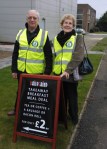
Hadleigh Street Watch


With Glenn Abbassi
With Glenn Abbassi

I am a volunteer member of Hadleigh Street Watch. Our commitment is to walk the streets (patrol sounds too official) in pairs for at least two hours a month. Today I joined Glenn Abbassi on our first walk of the year. We just beat the rain and purposefully wandered from the War Memorial, up to Tower Mill Lane and a look at the new  Persimmon Estate by Lady Lane, then across to Malyon Road, Oxford Road, the new Morrison’s, a look at the Brett River and back onto the High Street.
Overall people at pleased to see us and occasionally stop whatever they are doing to take a break and fill us in with their activities.
Personally I find the opportunity to walk my town very beneficial. We even got to enjoy a coffee shop (called the Daily Grind tel: 01473 823267) on the Industrial Estate. The Daily Grind has been open for about three months and produces a very nice espresso and cappuccino.  It is an ideal place to stop off at when going to and from the recycling centre or any of the businesses on the Industrial Estate. The Daily Grind is open from Monday to Friday and as well as teas and coffees they also serve sandwiches, pastries, jacket potatoes, muffins, slices, cakes and cookies. They offer a take out service and will also provide buffets for meetings.
For more details of volunteering for Street Watch please contact the co-ordinator Verity Line (Verity.Line@suffolk.pnn.police.uk).

Another Hero Passes

Glass_of_red_wineFriday’s Telegraph (December 28th) reports that Serge Renaud has died aged 84. He was a renowned research scientist who became a hero of the French wine industry when he announced on American television that drinking red wine is good for the heart. Renaud argued that the two or three glasses of red wine most French people consumed every day with their meals was a significant reason for their better health. Challenged to show figures to back up his claims about red wine, in an article in The Lancet in 1992 he drew on epidemiological research and data of his own to claim that 20 to 30 grams of alcohol a day (about two to three standard glasses of wine) could reduce the risk of dying from a heart attack by 40 per cent. Wine protects the heart, he maintained, mainly by acting on platelets in the blood to prevent clotting. The obituary did not say how he died but he managed to live to 84 and obviously worked hard enjoying himself.
So let’s raise a glass of Bordeaux to his memory and his efforts to improve our life styles.
The full obituary can be found on http://www.telegraph.co.uk/news/obituaries/9766180/Serge-Renaud.html

Jargon Generator

DictionaryThe Economic Jargon Generator (http://www.dack.com/web/bullshit.html) is a joke page meshing triple vocabulary elements to produce high falutin’ expressions defined as always to baffle the brains of the recipient. Which is why I tell myself that the five/six most important words a politician can say are: “I don’t understand, please explain”. One of my New Year resolutions will be to try to avoid being accused of using the jargon generator. Now that is a fundamentally irrevocable undertaking!

This Moose Belongs to Me

Do childrenThis Moose Belongs to Me’s stories need a point? Can’t they just be quirky and entertaining? Chris Van Allsburg in the New York Times (in reviewing This Moose Belongs to Me) opines:
The illustrations in … are perfectly suited to the nonsensical story (told). The reinforce the comic sensibilities inherent in the material and established the absurd reality essential for the absurd texts that accompany them.
However, even as the book passes the test of making fun while still making a point, it is not clear exactly what those points are.
The review and summary are as follows:
“In “This Moose Belongs to Me,” Oliver Jeffers presents Wilfred, a young boy who owns a moose that simply “came to him a while ago and he knew, just knew that it was meant to be his.” The moose, whom he names Marcel, has a role that lies somewhere between imaginary friend and willful pet. Wilfred attempts to control Marcel by imposing a set of rules. Then, while on a long walk, Wilfred discovers his moose is actually named Rodrigo and belongs to an elderly blue-haired woman. The moose rejects the boy for the old woman, and Wilfred rushes home, “embarrassed and enraged.”
En route, he becomes tangled up and trapped in the woods, and after a cold and lonely night, Marcel rescues him. This precipitates a renewal of the boy/moose relationship, one in which following Wilfred’s rules will be strictly optional for Marcel. The book ends with a cautionary note for Wilfred, when yet another possible owner hails the moose as “Dominic.” “
We have bought the book to read to the six year old grandson. Whilst the points may be unclear, they are nevertheless multiple and entertaining. We liked the book and we hope that the grandchild does!
http://www.nytimes.com/2012/11/11/books/review/the-other-side-of-town-and-this-moose-belongs-to-me.html?_r=0)

Hadleigh Local Shopping Loyalty Card

Hadleigh Loyalty CardWhilst many major companies are lawfully avoiding UK taxes, they are nevertheless depriving our Exchequer of the revenues needed to provide the services and building we need – and they are also attacking our own home grown business which find it difficult to compete against people who pay little or no tax. So it’s no more Starbucks for me. In future I’ll look for Costa (owned by Whitbread).
I’m going to try to give up Amazon and instead use our local bookshop The Idler.
Hadleigh has its own Local Shopping Loyalty Card. Collect a card and get it stamped ten times by local participating retailers (look for the window decals). Hand in the card when completed and participate in a monthly cash draw (£250 in December). If we do not support our local shops – then one day they will not be there.

Looking for a Home

This week’s The Tablet http://www.thetablet.co.uk/blogs/373/17 contains an interesting discussion on the possible discovery of Richard III’s bones under a car park in Leicestershire and their subsequent reinterring. One would have thought that finding and authenticating the bones would be the end of things. But No! The Tablet highlights the arguments as to where to re-inter the bones. In Westminster Abbey (because he was a king), in Westminster Cathedral because he was Catholic (the national religion at the time), Leicester Cathedral because the current location of the bones is within its diocesan boundaries or a Franciscan friary in Nottingham because that is the nearest to the excavation.
Meanwhile the country is still split three ways as to the appropriateness of Richard’s reputation.
Some think that it is well deserved. Others feel that he was traduced by supporters of the Tudor usurpers (i.e. Shakespeare) and other (of course) are not bothered either way.
During Richard’s reign, the historian John Rous praised him as a “good lord” who punished “oppressors of the commons”. After his death, Richard’s image was blackened by his Tudor successors, culminating in the famous portrayal of him in Shakespeare’s play Richard III as a physically deformed Machiavellian villain who cheerfully commits numerous murders in order to claw his way to power. I’m beginning to understand why I once was a member of the Richard III Society.
The Society’s home page (
http://www.richardiii.net/)  includes the following quotation “”… the purpose and indeed the strength of the Richard III Society derive from the belief that the truth is more powerful than lies – a faith that even after all these centuries the truth is important. It is proof of our sense of civilised values that something as esoteric and as fragile as reputation is worth campaigning for.” – HRH Prince Richard, Duke of Gloucester, KG GCVO


Six Principles for Happiness

Moneyweek features a blog by Eric Barker (http://www.bakadesuyo.com/archive/9/2012?page=2), which suggests that there are six key principles for happiness in life and career. (I particularly like No. 3 and 6).The principles are taken from Daniel Pink’s book, The Adventures of Johnny Bunko: The Last Career Guide You’ll Ever Need.

1.      Don’t plan. Things rarely work out as you intend them. Act instead according to your fundamental values and beliefs – this is more effective and rewarding.
2.      Think strengths, not weaknesses. Don’t try too hard to improve what you’re bad at; instead, capitalise on what you’re good at.
3.      It’s not about you. The most successful people improve their own lives by improving others’ lives. And they’re happier while doing it, too.
4.      Persistence trumps talent. What any one person in the world can learn, almost all of us can learn. What makes the best musicians? Nothing but hard work.
5.      Make excellent mistakes. The most successful people make big mistakes and learn from them – each time they get better and move a little closer to excellence.
6.      Leave an imprint. Visualise your funeral and consider what you would want friends to describe as your legacy. Thinking about death can actually be a good thing – it can improve physical health and help us re-prioritise our goals and values.   

Wattisham Flying Station

One of this week’s fortunate happenings was to be invited to a cocktail party and beating retreat at the Wattisham Flying Station. The last time I was mixing with operational military air crew was in Salalah in 1982. That of course was a different world. The young officers today have done their tours of Afghanistan and finished their Top Gun Training in the U.S. The Army reckons that it costs about £3.5 million to train Apache Helicopter pilots. You get a sense of what a machine the Apache is when it weighs over nine tons fully loaded and can be thrown around the sky at 180 m.p.h. Not that any throwing around is done. These machines cost around £35 million each. The cocktail party was fortunate insofar as Suffolk County Council are initiating a Community Covenant With The Armed Forces. On first reading the Covenant strikes one as being a tad flabby. It is apparently meant as first steps and obviously it cannot be a one size fits all as the various units and communities have different needs. I was in total awe of the personnel whom we met. They are very professional and certainly good value for money. They do deserve our support and one of my ambitions is to make it easier for our veterans to settle in communities of their choice – or as one veteran once put it to me “I can’t go back to where I enlisted. If I become homeless in Camden my wife will divorce me”. We need to work out better ways to support our military.

Wind Turbine

Courtesy WikicommonsI publish a monthly column in the Hadleigh Community News called Out of the Frying Pan. The point of the column is to highlight and comment on what is happening in Babergh from the point of our town. The aim is to be informative and occasionally entertaining. Hopefully I focus on some of the issues creeping under the radar. In July I wrote of a proposal for a 18 metre (59 feet) wind turbine off the Pond Hall Road. The 18 metres was from the ground to the top of the turbine and did not include the total height of the turbine blades. By contrast the only turbine in Hadleigh is only 9 metres high. The flag pole outside Babergh’s Corks Lane offices is 6 metres high. Although the site is in pasture, the turbine would be visible from the Pond Hall Road (400 metres/433 yards away) and would be extremely visible from the proposed housing area being planned for the land south of Tower Mill Lane and east of Frog Hall Lane. This week’s good news is that the planning application has been withdrawn. So a small triumph for common sense. Forward with the people

The Artist

At the weekend we took ourselves off to Leavenheath where the village hall was screening The Artist.  The hall is part of the Suffolk Digital Cinema Network (a non-profit association) which encourages community film screenings across Suffolk.  Network members borrow digital projection equipment, and get advice and training on how to run properly-licensed screenings in their own venues. Members choose the films they show to meet the needs of their local audiences. There were just under fifty people in the audience and it all went very well. There was a interval during which we could buy drinks and ice creams. I fully recommend The Artist which is a 2011 French romantic comedy-drama film in the style of a black-and-white silent film and stars Jean Dujardin and Bérénice Bejo. The story takes place in Hollywood, between 1927 and 1932, and focuses on the relationship of an older silent film star and a rising young actress as silent cinema falls out of fashion and is replaced by the “talkies”. (A sort of Singing in the Rain without the wetness).  Some might argue that the real star of the film is Uggie, Dujardin’s Jack Russell .
Sound finally comes in as the film starts rolling for a dance scene with Dujardin and Bejo. Once the choreography is complete, the two dancers are heard panting, and this is only time in the film sound is heard coming from Bejo, who otherwise says nothing. The director of the musical calls out audibly, “Cut!” to which producer adds: “Perfect. Beautiful. Could you give me one more?” Dujardin, in his only audible line, replies “With pleasure!” revealing his strong French accent. The camera then pulls back to the sounds of the film crew as they prepare to shoot another take.
Well worth a trip to one of the villages and well worth seeing the film again